Fashion
Women
Flappers were modern young women who wore their skirts short, their hair bobbed, and their lips red, who smoked cigarettes, danced in jazz clubs, flattened their breasts, went out unchaperoned, and flouted the Prohibition laws by swilling martinis in speakeasies. It is a misconception that women wore very short skirts in the twenties. In reality, they wore dresses mid-calf to the ankle for a very long time!


Some women wore a cloche hat, put on a wrap-over coat, styled their hair in a bob, wore short dresses, applied bright lipstick, wore Mary Jane ankle strap button shoes, taped their chests flat and smoked long cigarettes. Coco Chanel also emerged in the 1920s as a leader in women's fashion design.
Men
Men dressed conservatively compared to the women. They usually dressed according to their class. The fashion was to wear high-waisted suits and jackets, and pants were long, straight and worn slightly too short to expose a man's socks. Men had their hair slicked back and wore hats often.


Dating


There was nothing resembling our concept of dating until the 1920s. Before that decade, a man courted the Woman of his Dreams in her home, under the watchful eye of her parents. One of the most scandalous concepts of the 1920s was the idea of young girls going to speakeasies, restaurants, and parties unchaperoned. They could drink, smoke cigarettes, bob their hair, and dance all the immoral fad dances.
Theatre
Vaudeville
Vaudeville was a genre of entertainment that lasted from the 1880s to the 1930s. Each performance was made up of a series of separate, unrelated acts grouped together on a common bill. Types of acts included popular and classical musicians, dancers, comedians, trained animals, magicians, female and male impersonators, acrobats, illustrated songs, jugglers, one-act plays or scenes from plays, athletes, lecturing celebrities, minstrels and movies.

The Essanay Film Company produced silent films out of their Chicago studios, and later from Southern California. It started production in 1907 and had considerable success. For one year, Charlie Chaplin made films here, including his famous “The Tramp” (1915). Essanay opened with three other small companies in 1918 and that group combined with Warner Brothers in 1925. While this rejection slip isn’t dated, it came from the company’s Argyle Street address, which was their headquarters from 1908 until the 1918 name change, so it must come from that ten-year period.
Female and Male Impersonators

Both vaudeville and burlesque had their share of female impersonators, men who fooled the audience with their feminine clothing, voices, makeup, and mannerisms. Usually at the end of the act, they would pull off their wigs and revert to men, swaggering off stage and using a deep, masculine voice. Women impersonating men on the stage were not as common as men impersonating women. While female impersonators could really fool an audience, one veteran vaudeville player claims that male impersonators, no matter how good, still always looked female.
Movies

The very first Academy Awards was held in 1929.

Oscar Micheaux, the son of slaves, was the first African-American to make a movie. He started his own production company in 1919 in order to make a film version of his novel, THE HOMESTEADER, and he filmed it in the silent movie capital of the world, South Dakota.
Stars
The year 1921 was a landmark year in silent films.
Charlie Chaplin

Chaplin used mime, slapstick and other visual comedy routines, and continued well into the era of the talkies, though his films decreased in frequency from the end of the 1920s.Chaplin was one of the most creative and influential personalities of the silent-film era. His is also the 10th greatest male screen legend of all time.
Rudolph Valentino
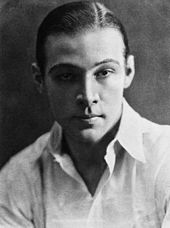
He was an Italian actor, and early pop icon. Known as the "Latin Lover", he was one of the most popular international stars of the 1920s, and one of the most recognized stars of the silent film era. He is best known for his work in The Sheik and The Four Horsemen of the Apocolypse. His death at age 31 caused mass hysteria among his female fans, propelling him into icon status.
