Music
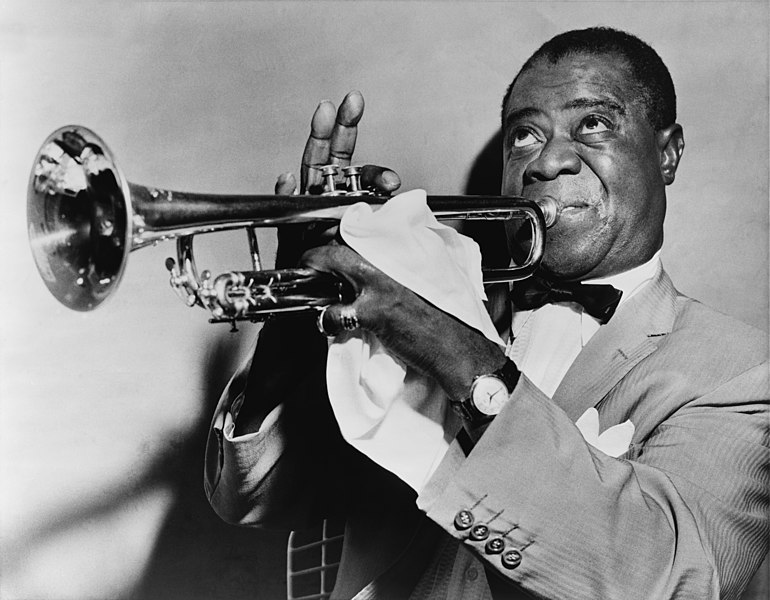 (Louis Armstrong)
The 1920s in America has also been referred to as the Jazz Age. Musician Louis Armstrong was foundational as he was an inventive American jazz trumpeter and singer from New Orleans. Louis Armstrong was also skilled at scat singing, another popular form of music in the twenties. Jazz was helpful in creating a shift in popular music towards modernism and dances like the Charleston. Duke Ellington and Cole Porter were also famous jazz artists. Bessie Smith was famous for her blues music, another popular form of music in the 1920s. By the mid-1920s, jazz was being played in dance halls and roadhouses and speakeasies all over the country. Early jazz influences found their first mainstream expression in the music used by marching bands and dance bands of the day, which was the main form of popular concert music in the early twentieth century. The 1920s were also Broadway's prime years, with over 50 new musicals opening in just one season. Record numbers of people paid up to $3.50 for a seat at a musical. It was also a decade of incredible artistic developments in the musical theatre.
Paintings
Modernist paintings were a revolt against realist paintings. A huge part of modernist painting is that is shows a person's self-consciousness, and the feeling that traditional painting styles were outdated and needed to be replaced by the energetic, fully-industrial world America was becoming.
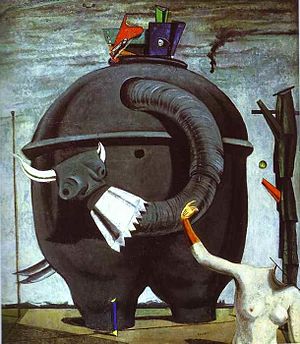 (The Elephant Celebes by Marx Ernst)
Surrealism
The Surrealism movement began in post-World War I European avant-garde literary and art circles, and many early Surrealists were associated with the earlier Dada movement. The Surrealists developed techniques such as automatic drawing, automatic painting, decalcomania, frottage, fumage, grattage and parsemage that became significant parts of Surrealist practice.
Salvador Dali


The imaginative dream world of Dali’s art contains everyday objects realistically depicted, but deformed or weirdly juxtaposed with other objects, creating a hallucinatory view. Surrealist Art showcases eccentricity and idiosyncracy, declaring it is not indicative of madness. Dali, considered quite idiosyncratic, said there was only one difference between himself and a madman—he was not mad.
Salvador Dali


The imaginative dream world of Dali’s art contains everyday objects realistically depicted, but deformed or weirdly juxtaposed with other objects, creating a hallucinatory view. Surrealist Art showcases eccentricity and idiosyncracy, declaring it is not indicative of madness. Dali, considered quite idiosyncratic, said there was only one difference between himself and a madman—he was not mad.
American scene painting
American scene painting was a naturalist style of painting that adopted academic realism in depicting American rural and urban scenes.
Art Deco
Art Deco Design, which originated in France, was a major decorative style in the United States during the 1920s. It shaped all areas of design: architecture, interior, furniture, textile, crystal and glass, silver and metal, industrial, painting, sculpture, graphic art, film, fashion, and jewelry. It was a movement in decorative arts that also affected architecture. It derived its name from the World's fair held in Paris in 1925, which showcased French luxury goods. Art Deco did not originate with the Exposition; it was a major style in Europe from the early 1920s, though it did not catch on in the U.S. until about 1928. Art Deco is characterized by use of materials such as aluminium, stainless steel, lacquer, inlaid wood, shark-skin, and zebra-skin. The bold use of zigzag and stepped forms, and sweeping curves, chevron patterns, and the sunburst motif.


